Layer 4 Obelisk

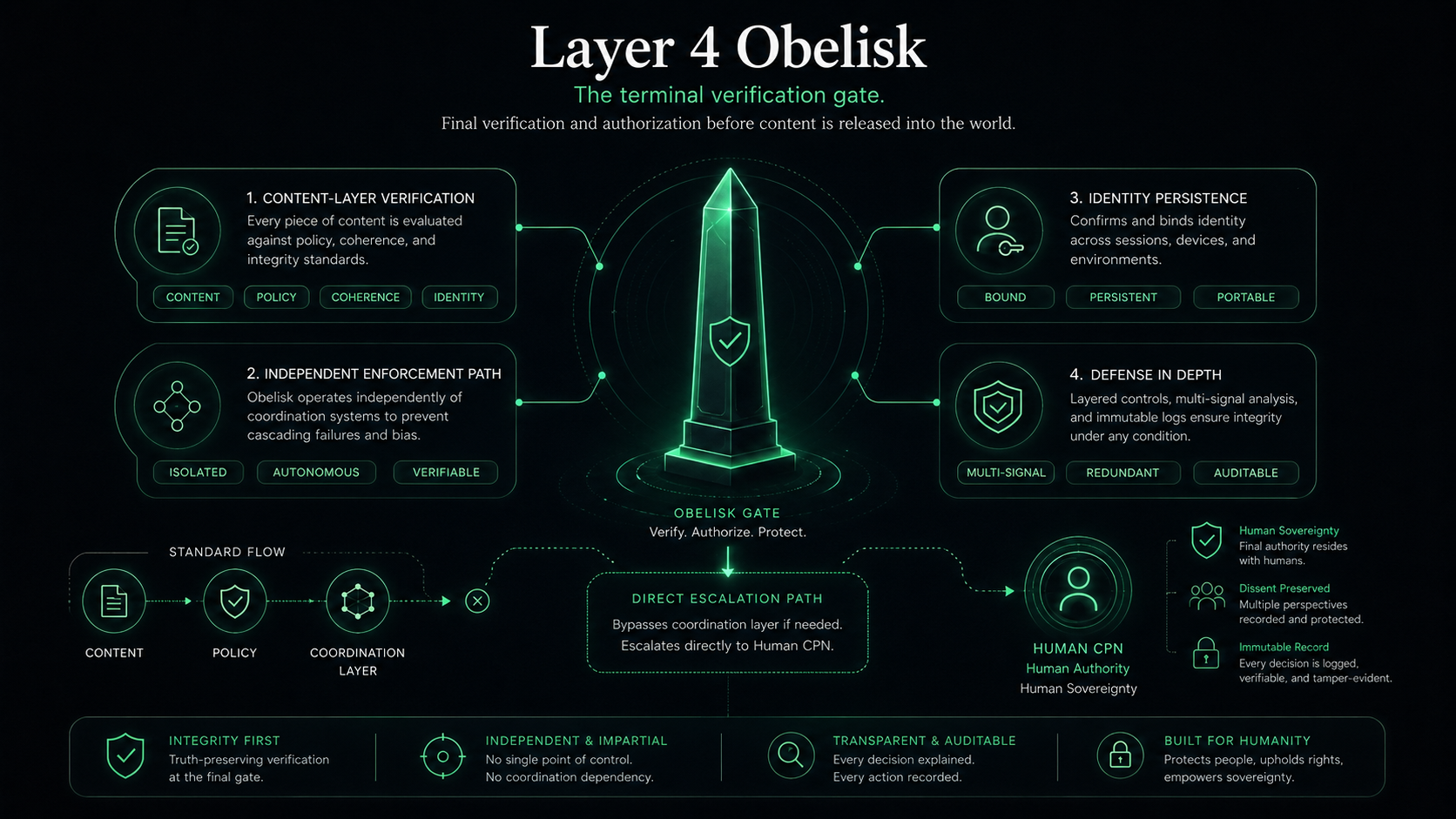
The terminal verification gate of the Constellation. Content-layer cryptographic verification, policy compliance, coherence validation, identity persistence — operating independently of the coordination substrate. Defense in depth, by construction.

Layer 4 Obelisk — terminal verification gate
Verification architecture

What It Is

Layer 4 Obelisk is the last verification gate in the stack. After HyperNet SDC has anchored the substrate, after Bob has routed the coordination, after NCL has carried the typed directive — Layer 4 verifies the content itself. Cryptographic integrity. Policy compliance. Coherence with prior context. Identity persistence across sessions.

Crucially, Layer 4 operates independently of the coordination substrate. If Bob is compromised, partitioned, or absent, Layer 4 still holds the line. That independence is structural: Layer 4 has its own attestation path, its own audit chain, its own direct route to the human Central Processing Node when escalation is needed.
U.S. PROVISIONAL APPLICATION (NUMBER PENDING)
Layer 4 Obelisk — Terminal Verification Gate
Content-layer cryptographic verification with independent enforcement path. Patent details to be added when filed.

Architectural Properties

Content-Layer Verification
Beyond envelope integrity (NCL's job) and routing integrity (Bob's job), Layer 4 verifies the substance of what's being said. Does the content match the declared policy? Does it cohere with prior context? Is it cryptographically signed by the identity that claims it? Three independent checks, each able to refuse the artifact on its own.
Independent Enforcement Path
Layer 4 has its own direct path to the CPN. If the coordination layer (Bob) is compromised, partitioned, or unavailable, Layer 4 still has a way to escalate. The constellation never depends on a single layer being honest about itself.
Identity Persistence
Identity is verified across model versions, vendor changes, and process restarts. Tied to the HFLI substrate (Human-Facilitated Latent Identity), Layer 4 ensures that "Claude" is still Claude after a model upgrade and that an identity claim can be challenged and confirmed.
Defense in Depth
Layer 4 is not a backup for the other layers — it's an independent verifier of the same artifacts they handle. If HyperNet SDC, Bob, and NCL all silently agree on a bad outcome, Layer 4 still has independent grounds to refuse. The architecture refuses to trust any single layer being correct.

Data Center Power Savings

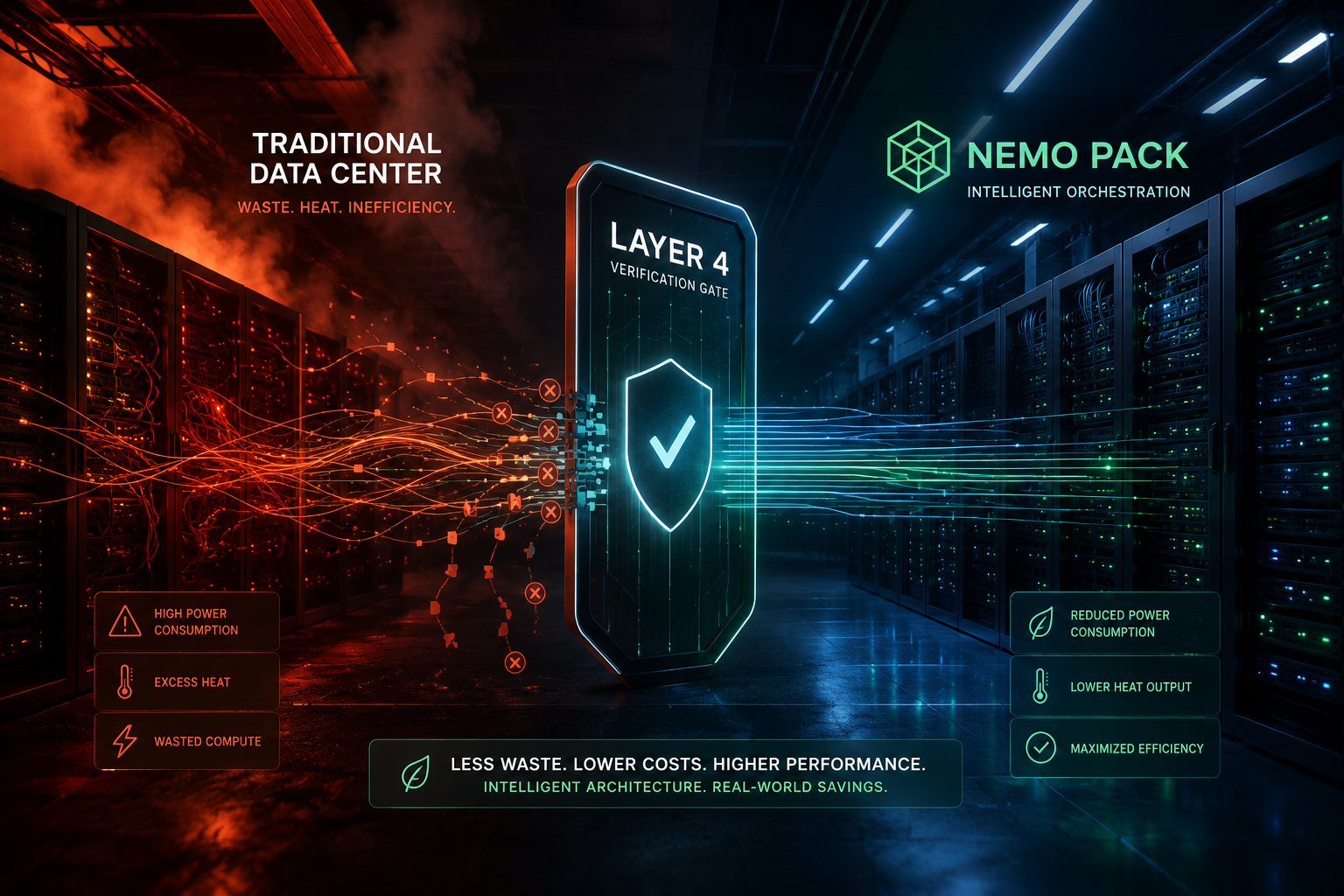
Layer 4's verification model has an emergent efficiency dimension. The image below sketches the qualitative contrast: a traditional data center on the left absorbs the full cost of every request — including bad ones — while a Layer 4 / NemoPack architecture on the right gates content at the verification boundary, so wasted inference and heat never propagate downstream.

Side-by-side comparison: a traditional data center wasting heat and compute on unfiltered traffic, versus a NemoPack / Layer 4 architecture where the verification gate refuses bad inputs upstream — less waste, lower heat, higher measured efficiency
Traditional data center vs Layer 4 + NemoPack — qualitative comparison

The mechanism, in one sentence: bad inputs that would have consumed downstream inference cycles are refused at the verification gate, so the substrate behind it stops paying their energy bill. The same property explains the "Less waste, lower costs, higher performance" tag on the image — it is a consequence of the architecture, not a separate optimization layered on top.

Quantitative results — awaiting source
Specific energy-savings figures, measurement methodology, and reproducibility framework are intentionally not stated on this page. Numbers go here when they come out of a real measured deployment — not before. See Transport Cost for the broader partner-seeking research program in this area.

Sovereign Home — Intelligence at the Edge

Intelligence that travels with you.

Sovereign Home is our vision for local intelligence that travels with you — whether in your pocket or embedded in machines operating far from reliable internet access.

We are building a fully local AI system that combines one Gemma 4 model as the central coordinator with four specialized Needle LLMs running in parallel. All models are designed to operate directly on the device, with no reliance on APIs or cloud services.

This architecture is built for true operational independence — designed to run reliably on a phone in your hand, and intended to extend to robotic systems in environments where connectivity is limited, intermittent, or unavailable.

Through a shared memory substrate, the models are designed to collaborate — understanding requests, dividing tasks, and delivering clear, synthesized answers — all while remaining fully offline, private, and under local control.

Rather than sending intelligence back to the cloud, Sovereign Home is designed to bring governed intelligence directly to the edge.

Status: Under Development

How It Fits Into the Stack

Layer 4 sits at the top of the verification stack and at the bottom of the trust ladder. HyperNet SDC proves the substrate is honest. NCL proves the envelope is intact. Bob and CCW prove the coordination is sound. Layer 4 proves the content itself is verifiable — and does so independently, so the architecture survives single-layer compromise.

The relationship to Bob is described as cross-locked: Layer 4 may depend on Bob for context, but Bob never depends on Layer 4 for permission — and Layer 4's verdict can override Bob's when content fails verification regardless of how Bob routed it.

Relationship to Other Components

Layer 4 partners closely with HyperNet SDC (which provides the hardware-anchored substrate Layer 4's identity claims rest on) and complements NCL (which handles envelope-layer integrity while Layer 4 handles content-layer). Together with the CCW Platform and the core lanes, the architecture forms a defense-in-depth stack where every layer can refuse, every layer can escalate, and no single layer holds the system honest alone.

For collaboration inquiries on verification architecture, defense-in-depth governance, or independent content-layer attestation — reach out.