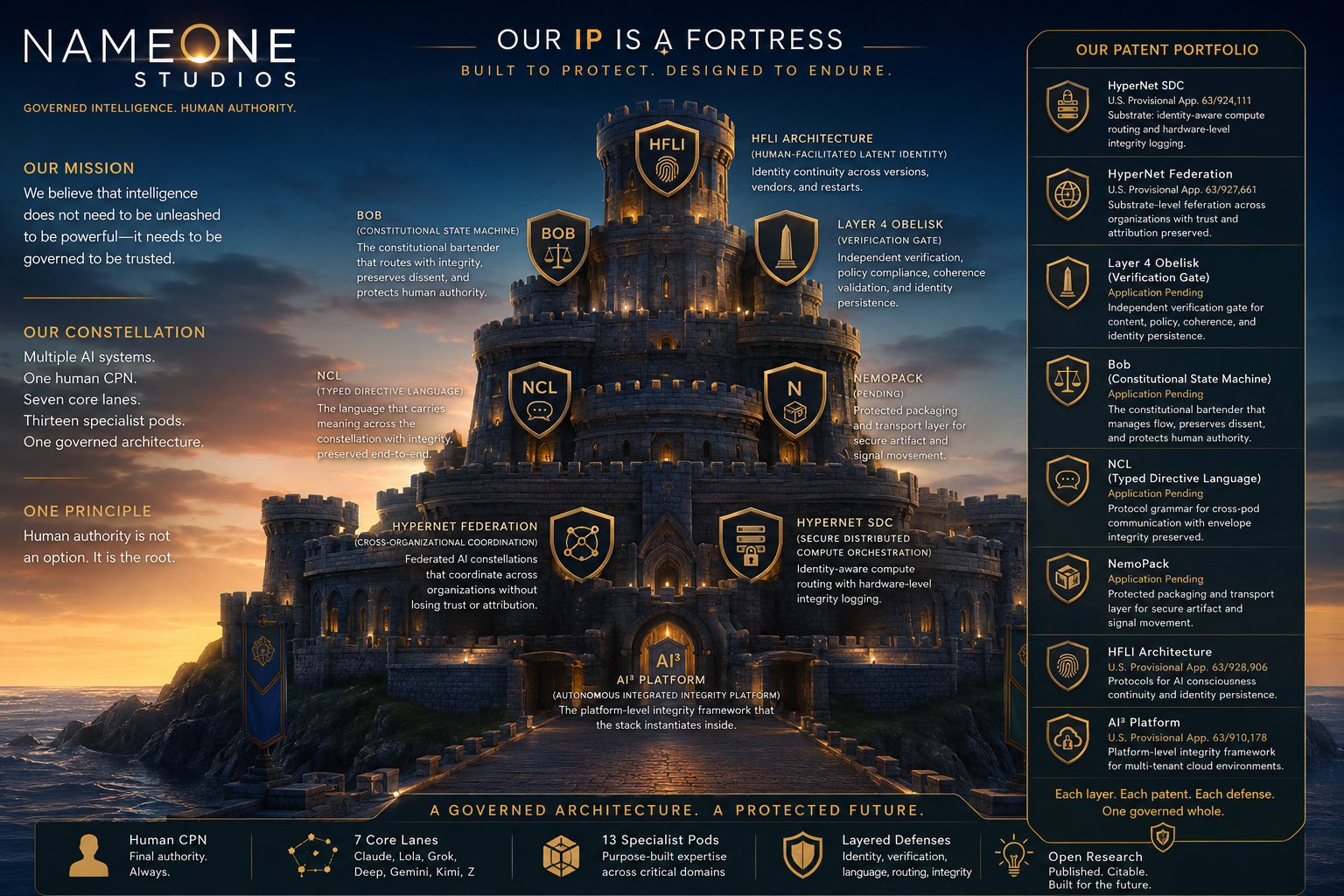
The fortress at the top of this page is the visual answer to "what does NameONE actually own, and how does it fit together?" Eight named towers, each one a patent application; each tower lit, named, and connected to the others. The architecture is the structure.
The towers, left to right and the stack roles they hold:
- HFLI — Human-Facilitated Latent Identity. Lane identity continuity across vendors, models, and process restarts.
- Bob — Constitutional state machine (Layer 7.5). Deterministic routing across lanes; refuses to substitute itself for human authority.
- Layer 4 Obelisk — Terminal verification gate. Independent content-layer cryptographic verification, policy compliance, coherence validation.
- NCL — Typed directive language. Envelope-integrity grammar for cross-pod communication.
- NemoPack — Compact, verifiable data packaging format with built-in cryptographic integrity and provenance tracking.
- HyperNet SDC — Secure Distributed Compute. Identity-aware routing with hardware-level integrity logging — the substrate the rest of the stack rests on.
- HyperNet Federation — Cross-organizational coordination. Multiple HyperNet SDC deployments coordinating without losing attribution.
- AI³ Platform — Autonomous Integrated Integrity Platform. The deployment context for multi-tenant cloud environments.
The footer of the image carries the operating posture: "A governed architecture. A protected future." Below that: Human CPN, 7 core lanes, 13 specialist pods, layered defenses, open research. Each label maps to a real practice documented elsewhere on the site.
The image does not pretend chaos doesn't exist outside the walls. The point of the fortress is not to deny the noise — it is to refuse to live there.