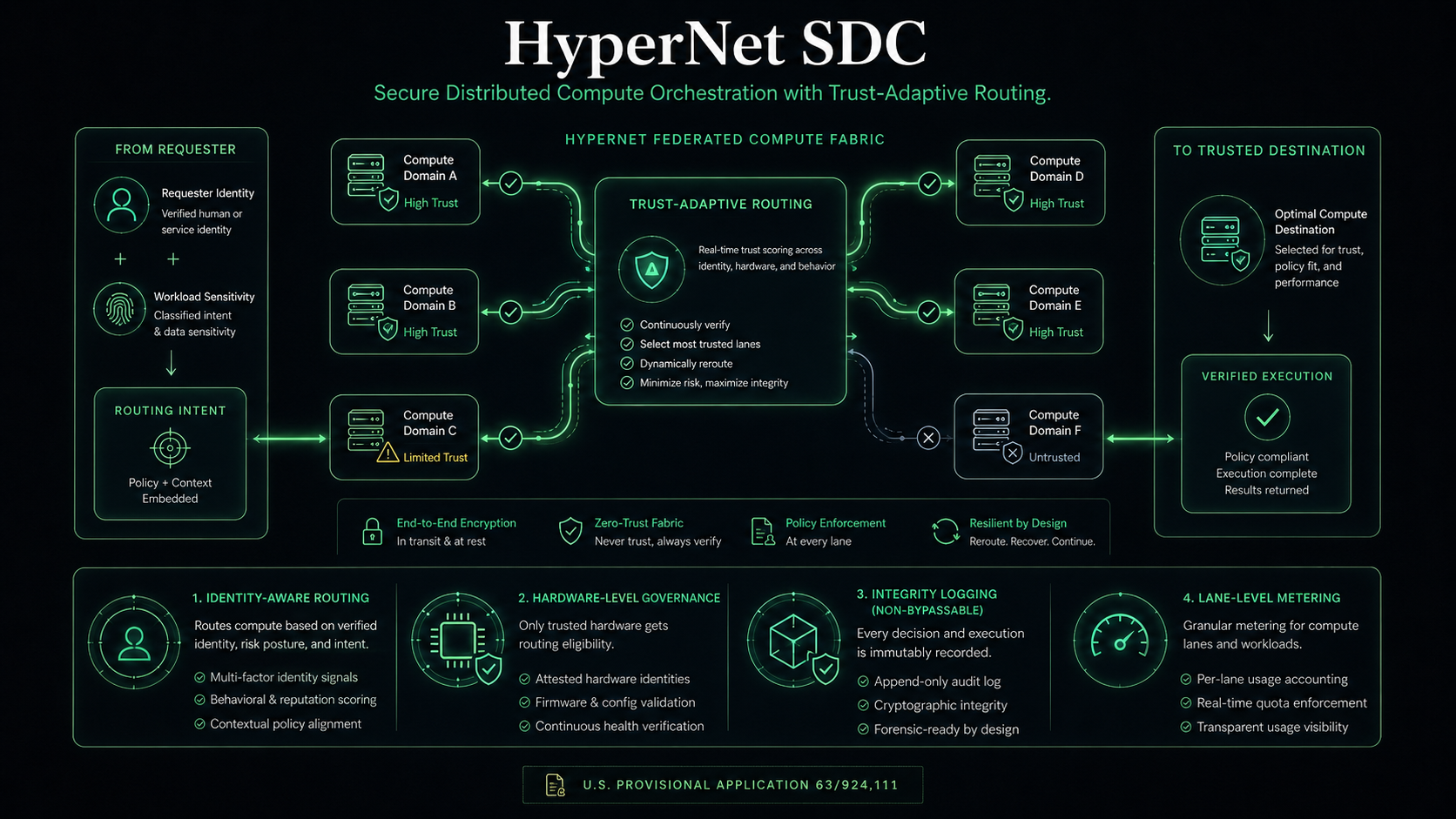
HyperNet SDC

Secure Distributed Compute Orchestration with Trust-Adaptive Routing. A federated architecture for governing where multi-AI work runs, who can see it, and whether the integrity of the route is provable end to end.

HyperNet SDC โ€” federated compute fabric with trust-adaptive routing
Federated compute fabric

What It Is

HyperNet SDC is the substrate layer beneath the constellation: a federated compute-orchestration architecture that decides which compute nodes can run which AI workloads, and proves the integrity of that routing decision after the fact.

Where most AI infrastructure today optimizes for latency and cost, HyperNet SDC optimizes for trust adaptivity โ€” the ability to route a workload based on the identity of the requester, the sensitivity of the work, and the verifiable trustworthiness of the available compute. Hardware-level integrity logging means routing decisions are not just made โ€” they're witnessed.

U.S. PROVISIONAL APPLICATION 63/924,111 ยท NOV 24, 2025
HyperNet Secure Distributed Compute
Trust-adaptive routing for distributed AI compute.

Architectural Properties

HyperNet SDC implements four governance properties at the orchestration layer. These are not added as software on top โ€” they're structural to how the routing fabric operates.

Identity-Aware Routing
Routing decisions consider the identity of the requesting agent (human or AI), the destination lane, and the trust relationship between them. A workload that requires a high-trust lane cannot be silently routed to a low-trust fallback.
Hardware-Level Governance
Governance constraints operate at the substrate, not in application code. Constraint enforcement that lives in hardware survives software faults, vendor changes, and even malicious orchestrator behavior โ€” the policy is the floor of the system, not a layer above it.
Integrity Logging (Non-Bypassable)
Every routing decision emits an integrity record into an append-only log. The log cannot be skipped, edited, or selectively suppressed โ€” its position in the data path makes evasion architecturally impossible, not just policy-prohibited.
Lane-Level Metering
Compute consumption is metered per AI lane, per customer, per contract. Multi-tenant deployments retain attribution and accountability even when many AI workloads from many customers share the same substrate.

Why At The Hardware Layer

Software-only AI safety has an unsolvable problem: the same layer that's supposed to enforce the policy is the layer that can be modified, bypassed, or socially engineered around. Governance that lives only in software is governance that depends on the runtime being honest about itself.

Pushing the governance floor into hardware changes the failure mode. A compromised software stack can no longer silently route around the integrity log; the integrity log lives below the layer that could compromise it. That's the foundational design principle: verification has to live deeper than the thing being verified.

Relationship to the Rest of the Stack

HyperNet SDC is the bottom of the stack. Above it: the CCW Platform coordinates lane-level decisions and synthesis. Above that: the constellation of seven core AI lanes plus thirteen specialist pods. Above that: a human Central Processing Node who holds final authority.

Each layer has its own job. HyperNet's job is to make sure the compute substrate is honest about itself โ€” that the routing decisions made above it are anchored to a verifiable hardware reality below them.

Status

Provisional patent filed November 24, 2025. Reference implementation in progress. Companion patent โ€” HyperNet Federation (U.S. Provisional 63/927,648) โ€” covers cross-organizational coordination of multiple HyperNet SDC deployments. We expect to publish architectural details progressively as patent prosecution advances.

For collaboration inquiries โ€” particularly from organizations working on hardware-level AI safety, confidential compute, or multi-party verifiable orchestration โ€” reach out.